Google Analytics

Showing posts with label Cooking. Show all posts

Saturday, March 24, 2012

Goolsby's Sausage Patty Melt

Man, oh man, do I love a good Sausage Patty Melt!

My wife, The Queen, made me great one today!  I've just finished it, and it's better than any I've ever had at Waffle House!

In case you aren't happily familiar with Sausage Patty Melts, it consists of fried sausage, on toast, with a thick slice of onion, coated with mustard, along with a dash of Tabasco sauce, and topped with cheese.  Man, oh man...

Today she made her's with Goolsby Sausage, which has become our favorite sausage, bumping out previous first place go-to sausage king Jimmy Dean Sausage.  See my other Goolsby's Sausage recipe here.

Here's the recipe:

Ingredients

  • 4 patties of Goolsby's Sausage.  We buy ours at Costco.
  • 1 thick slice of onion
  • 2 pieces of bread, preferably thick slice Texas Style, but any will do.
  • 2 pieces of sliced, extra sharp cheddar cheese
  • Mustard
  • Tabasco
  • Cooking pan with lid
Cooking Instructions


  • Cut a thick slice of onion.
  • Use cooking instructions on box for Goolsby's Sausage.  These sausages are preformed and frozen. 
  • Once sausage is done, reduce heat and remove sausage from pan.
  • build up the patty melt
    • Place slice of bread onto plate.  
    • Place all four pieces of cooked sausage onto bread.  Some overlapping may occur, but that's OK.
    • Cover sausage with mustard.
    • Add any desired Tabasco sauce.
    • Place onion onto mustard
    • Place cheese onto onion
    • Cover with remaining slice of bread
  • Transfer back to pan
  • Set temperature of pan to medium.
  • Cover pan with lid.  This will help the cheese to melt.
  • Cook until toasted on first side.
  • Flip to other side
  • Cook until toasted on second side.
  • Remove and serve with strong, black, coffee.
Enjoy!


Thursday, January 19, 2012

On Cooking Meat - letting it stand

I've done a series on cooking meat in this blog, but this is going to concentrate on a single aspect of cooking meat that is often overlooked, and that is - letting the meat stand for a few minutes after removing it from the cooking environment.

I'm going to provide some important insight into this step.  But first, I want to explain why it is necessary.

Alton Brown is one of my favorite cooking educators.  He does a show where he cooks the exterior of a steak, first on high heat in a cast-iron pan on the stove, then transferring it to the oven to cook the internals to the proper desired finishing temperature.  He then transfers it to an inverted plate for the juices to run away from the steak in order not to dilute the browned-surface of the steak while it rests....so far, so good.

Alton has two things going on here while he lets the meat rest.  The first is a method to prevent the juices that are still seeping from the meet to form a pool that the steak is sitting in.  This pool of fluids will dilute the browned crust that he worked so hard to put on while browning it in the cast-iron pan.

But why does he want it to rest in the first place?

Meat contains a lot of liquid.  I know this first hand from cooking BBQ using big pieces of pork.  Slow roasting cooked BBQ will reduce the weight of the meat by around 30%!  This is lost moisture, not lost meat.

When I was just starting the process of automating my cooking of BBQ (after the novelty wore off, I got tired of staying up all night tending a smoking fire), I inserted multiple channels of thermocouples into the cooking environment.  Some were in the combustion chamber (where the wood was burning), some were in the smoking chamber (where the meat was cooking), some were in the exhaust stack (where the smoke exited the cooker), and some were outside in the ambient air.  Some were also inside the meat.  I placed some on the surface of the meat, and buried several more, each going about 1 inch deeper than the previous thermocouple, until I had reached the middle of the meat.

I then proceeded to cook the meat using a controller that I built that would precisely control the temperature of the smoke chamber to within 2 degrees by opening and closing the inlet air damper.

From this series of tests, I was able to note an interesting thing.  The internal temperature of the meat would gradually increase, in a logarithmic manner manner (temperature increasing faster at first,  but gradually the increase grew slower and slower until it more-or-less flat-lined).  This internal meat temperature would hold steady for hours....and then the temperature would start taking off higher again!

What the heck was going on?  The combustion chamber, smoke chamber, and exhaust stack were not changing temperature, yet the internal temperature of the meat was suddenly climbing after hours of not moving.   So what was going on?

Well, I'll tell you.  The meat had been seeping moisture from the internals to the surface of the meat, where it would evaporate in the hot smoking chamber.  You could not actually see this moisture moving away from the meat.  But it was moving off of the surface of the meat, leaving behind brown-goodness, AKA Maillard Browning.   This fluid, moving off of the surface of the meat into the air of the smoke chamber works the same way your skin works in perspiring - the fluids you perspire evaporate away from your skin, taking heat with it, and keeping your body cool.

The meat, in having fluids move to the surface, where it evaporated into the smoke chamber's air, was removing heat from the meat.  So, as soon as the meat ran out of fluids that could remove the heat through evaporation, the internal temperature of the meat started to rise.  So when this occurs, you have direct evidence that the meat has given up it's moisture and now is a heavy slab of dried out meat.

So what makes the moisture move to the surface of the meat anyway?  Obviously heat is involved.  And when you heat something with water in it that is enclosed, then the internal pressure of the meat is raised.  So by heating the meat, the fluids inside the meat are heated, and this heat raises the pressure of the fluids trapped within the cell walls.  Rising the temperature high enough and long enough will cause the fluids to push their way out of the cells, and eventually cell wall to rupture and release all of the remaining fluids.

So pressure, due to increased temperatures, pushes the fluids out of the meat.  And fluids leaving the meat take heat from them.  And if the temperature of the oven is low enough, then there will be a balance struct between the internal temperature of the meat and the temperature of the smoke chamber - the internal temperature of the meat will stay constant, as long as moisture remains in the meat.  As soon as the meat runs out of moisture, the internal temperature of the meat will start to climb.  Now, this can be overcome if the oven temperature is significantly higher than the temperatures used in cooking BBQ, just like your body can be overheated while perspiring if the outside air temperature is high enough.

 So I can observe this when I make BBQ, because I cook mine at 185 - 190 typically, for a period of 24 hours.  And it's an interesting thing to see.

So all of this to get back to the one thing - how to properly rest the meat.

We now know why we want to do this - by removing the meat from the heat source, we are allowing the internal temperature of the meat to lower, and we now know that this lowering of internal temperature will result in lower pressure, so the fluids will no longer be squeezed out of the meat.  And assuming you don't want dry meat, this is a good thing!

But the last piece of this puzzle is how to allow the meat to cool (or rest) so that the outside Maillard Browning crust isn't diluted by the pooled fluids?

Alton Brown using an inverted dish to place his meat on while enclosing the whole thing inside aluminum foil.  But this is sort of awkward.

Instead, I put my steak to rest on a pie-cooling wrack (it stands just 1/4 inch above the surface it rests on).  I put down a piece of aluminum foil, set the pie-cooling wrack on it, then the steak, then tent the whole thing and let it rest this way for 10 minutes, and bingo!  I've got my perfect cooked steak.

My whole method for cooking steak indoors:

  1. Heat a cast-iron pan on the stove on high heat with just a little bit of oil in it, preferable canola oil as it can take higher heat best.  The oil is really there to help transfer the heat to the steak from the pan.
  2. When the oil just starts to smoke, reduce the heat a little and immediately add the steak to it.
  3. Brown on one side until it reaches a deep dark color before flipping to the other side.  Watch for smoke - if it's producing a lot of smoke than it's too hot and cut it back a little.  You'll just have to experiment with this.
  4. Cook this second side until it's done like the first side.
  5. While this is being performed, place a pie-cooling rack onto a plate large enough to let the rack stand on.
  6. Cut the heat off.
  7. Transfer the steak to the pie-cooling rack so steak fluids don't dilute the surface browning. 
  8. Now transfer the pie-cooling rack, which has the steak on it, to the top of the pan.  My pie-cooling rack overlaps the top edge of my pan so that the steak is sitting on top of the pan on the rack.
  9. Transfer the whole pan-and-steak to the oven, placing it into the top 1/3 of the oven preheated to 325 and cook it for about 10 minutes without turning.
  10. Put a piece of aluminum foil onto a plate.  This should be large enough for the pie-cooling rack and steak to sit in and be wrapped up on all sides, forming a tent.
  11. Remove the pie-cooling rack with steak and place onto the aluminum foil, then bring together and crimp all sides without letting it touch the steak on the sides or on the top.
  12. Leave it to sit for 10 minutes - resting.
  13. Serve!


Saturday, January 14, 2012

Banjo Cooks Breakfast with Goolsby's Sausage


Goolsby's Sausage, Stone-ground Cheese Grits, Eggs, Sausage and Cheese Stuffed Puff Pastry (like Hot Pockets).....OMG!

Note: for my Sausage Patty Melt using Goolsby's Sausgae, go here

This is a great breakfast!  It's big enough that it's breakfast and lunch!

Total Time: 45 minutes - 1 hour.

This recipe uses Goolsby's Sausage (frozen), which we obtain from Costco.  We used to cook with Jimmy Dean sausage, but after 36 years of happy marriage, we've switched to Goolsby's!

We particularly like this sausage because:
  • It taste great!
  • It's already formed into patties.
  • It doesn't need to be thawed before cooking
  • It's inexpensive - we are able to purchase 24 preformed patties (2 lb) for $7.00 at Costco.
  • We can just take out the number of patties we want to cook for that meal and return the rest to the freezer.
This recipe is assuming you will be cooking for two servings.

Ingredients
  • 1/2 lb (8 oz) Extra Sharp Cheese
  • 2 eggs (or more if you desire)
  • 1 sheet of Frozen Puff Pastry Sheets
  • 4 servings of stone-ground grits (see instructions that come with your grits)
  • 4 sausage patties (the times here are assuming you will be using Goolby's frozen sausage patties - if you use different, then you'll need to make some adjustments for your sausage cooking time.  Goolsby's takes 8 minutes to prepare).
Cooking instructions
  1. Note time now; you will base some steps as elapsed time from now.
  2. Start cooking stone-ground grits.  They will require about 45 minutes to cook.  Follow instructions that come with your stone-ground grits.  Make enough for 4 servings and some will be left over....they get better tomorrow!
  3. Remove puff pastry frozen sheets (1 sheet per 2 pastries) and place where it can thaw.  It will require about 40 minutes to thaw.
  4. Grate 1 lb of  Extra Sharp Cheese.  Set aside 1 cup for cheese grits.  The rest will be used in the stuffed puff pastry.
  5. About 30 minutes after start: Set oven to 400 dF and turn on.  Place a rack towards the top, maybe 3/4 up from bottom. Not critical, but placing it towards the top will help with not burning the bottom of the puff pastries.  Continue with rest of steps while oven comes up to temperature.
  6. About 30 minutes from start, heat pan to point where drops of water will rapidly sizzle.  If you have an electric skillet, place it for 375 and allow to come up to temperature.
  7. Place 2 of 4 sausage patties into skillet and cook, 4 minutes per side (for Goolsby's).  After 4 minutes on a side, flip to other side.  Total cooking time is 8 minutes.
  8. When pastry sheets have thawed, open up and cut in half width and cut in half length.  This will give you 4 equal size pieces.
  9. Place a large helping of shredded cheese onto 2 of the squares.  Heap it up.
  10. When sausage has finished cooking, place each sausage onto the cheese on a pastry square.
  11. Add lots of cheese to the top of the sausage.
  12. Place remaining 2 pastry squares onto tops of cheese-sausage squares.
  13. Crimp the edges together on each puff pastry.  
  14. Place into greased cookie tin and place into 400 degF oven.  Cook for 15 minutes.  Watch last 5 minutes to ensure you don't burn, as all ovens cook at different speeds due to differences in temperature controls.
  15. Stir cheese into grits, and recover.
  16. Take remaining 2 sausage patties and cook in skillet, with 4 minutes on the first side, then flip.
  17. Different step for cooking on the 2nd side of the sausage.  After flipping, cook 2nd side for 2 minutes, then reduce heat to 300 or moderate.  Sausage should still gradually sizzle now, but not a 'hot' sizzle.
  18. Open 2 eggs into skillet onto sausage oil.  
  19. Cover and let eggs and sausage cook until your desired level of cooking is achieved.  Using the cover will help the eggs to cook on top without burning the bottoms.
  20. When the puff pastries are ready, everything should be ready.
  21. Plat and serve!
We like to serve with: 
  • Chipotle Tabasco 
  • Orange juice
  • Strong, black coffee.

Monday, December 19, 2011

Banjo's Easy Shrimp Bisque - Sous Vide


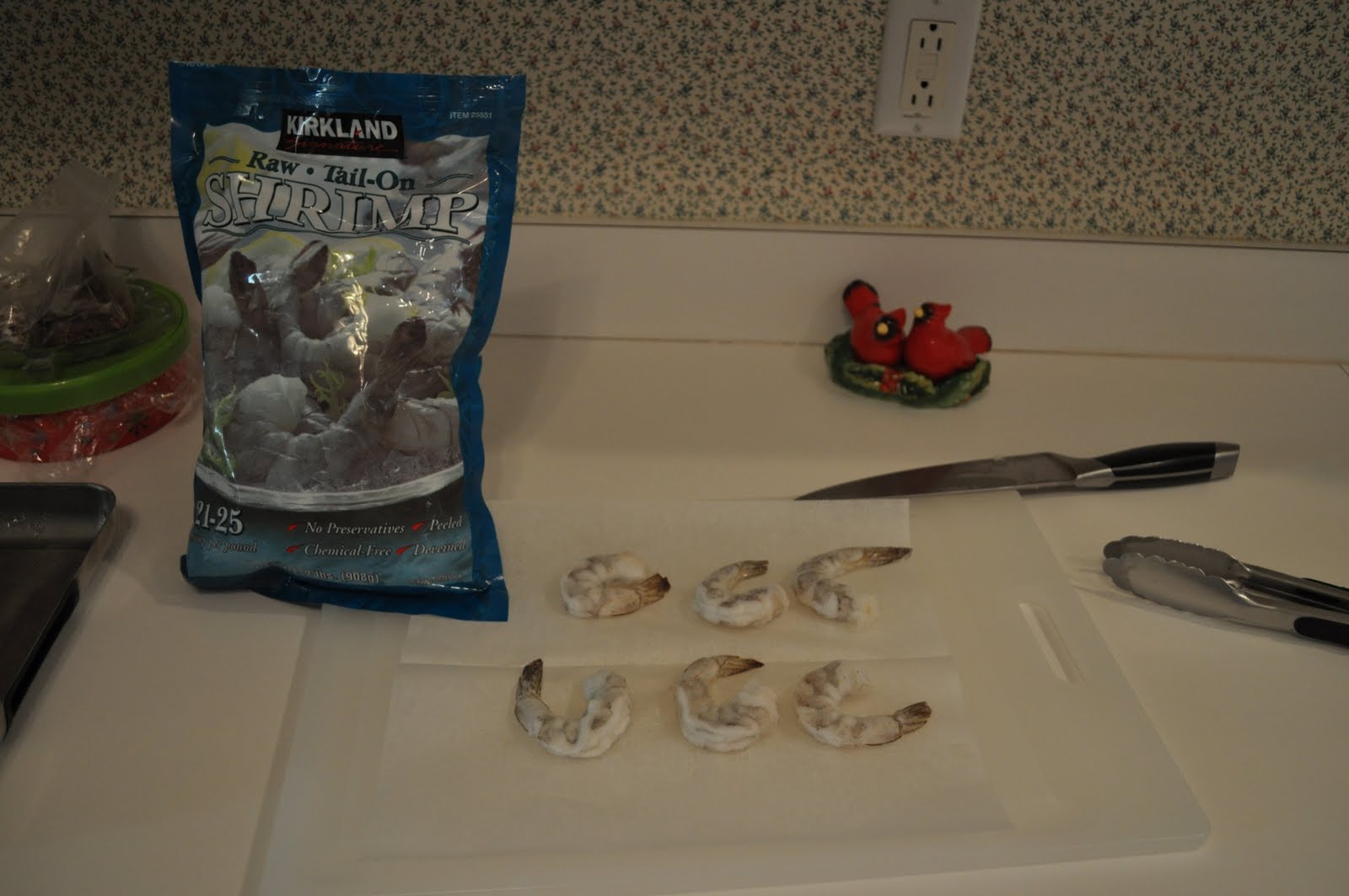
We recently bought a frozen package of shrimp from Costco.  It's labeled as Kirkland's Raw Tail On Shrimp, 21-25 count per pound, 2 pounds.


I've enjoyed using this shrimp in different ways to make different meals.

Today I'm going to make an original - Banjo's Easy Shrimp Bisque - Sous Vide.  It's easy because I'm using 2 cans of Bar Harbor Lobster Bisque as the base, and Sous Vide to cook it.

For those of you not familiar with Sous Vide, it is a water-bath immersion method of cooking utilizing precise temperatures.  For additional insight, see this link.  Since shrimp can easily be over cooked, this is a great utilization of Sous Vide cooking.  Note: there are several ways to cook Sous Vide, and I've done them all.  If you are doing this for home cooking, then have a look at the Sous Vide Supreme, a great home tool.


Servings

  • 2 - 4, depending on whether it's the main course or accompanying other elements.

Time

  • Prep: 15 mins
  • Cooking: 1 hour in Sous Vide (no attention required on your part - put it in and walk away)
  • Total: 1 hr 15 mins


Ingredients

  • 2 cans (10.5 oz each) of Bar Harbor Lobster Bisque.  Note: if you can't find this brand, then look for premium brands of bisque.  It can be lobster, shrimp, or crab.  Lobster is what our local grocery store carries.
  • 6 frozen (or fresh if you are local to a good source!) shrimp taken from 21-25 count shrimp.
  • 1 gallon Heavy Duty Freezer ZipLoc bag.
  • Optional: 1/4 cup cream
  • Sous Vide cooker.
Steps


    Sorry about the goofy alignment of the pictures.  Google Blog isn't giving me much capability to align them with the text.

  1. Preheat Sous Vide to 142dF.
  2. Remove 6 shrimp from frozen shrimp bag.
  3. Place into the ZipLoc bag.
  4. Remove all air from ZipLoc bag.  If not familiar with how to do this, go to youtube.com and view this video.
  5. Submerge ZipLoc into Sous Vide.
  6. Heat shrimp for 10 minutes to thaw - they should be orange-ish in color now. 
  7. Remove shrimp from ZipLoc bag and place onto cutting board.  Retain the shrimp-water that is in bag for flavor in bisque.
  8. Remove tails by pinching meat out while pulling on tail - this extracts all of the meat.  
  9. Discard tails (or you can retain and pull out later - your preference).
  10. Finely chop shrimp.  You want a real-fine grained chop here - pulp is good.
  11. Place ZipLoc bag into large bowl, and bend back the top of the bag so  the lip of bag doesn't get food on it.  The bowl is here to stop any mess while providing support for the bag to remain open while you are adding ingredients.
  12. Place shrimp back into ZipLoc bag.
  13. Add both cans of lobster bisque into ZipLoc bag.  If adding cream, add now.
  14. Close most of bag while squeezing air out of bag.
  15. Carry bowl with bag to sink, and fill bowl with water while preventing bag from filling with water.
  16. Remove all air from ZipLoc bag.  If not familiar with how to do this, go to youtube.com and view this video.
  17. Cook for 1 hour (or more - this is one of the beauties of Sous Vide Cooking) at 142dF.
  18. Serve into individual bowls.
  19. Top with a little cracked pepper, salt to taste.

Monday, December 5, 2011

Banjo Experiments with Sous Vide Shrimp

I haven't tried any shrimp yet via Sous Vide method (BTW- I have a SousVide Supreme.  I have also created my own cooking vessel using an Arduino to control the temperature, but this looks  a lot nicer in the kitchen.)

This is an experiment, so it may evolve over several iterations.  For this first iteration, I'm using a temperature I found on the internet: 140 dF for 1 hour.  I have misplaced my cook book, so that's the best I can do for tonight.

I've selected 1/2 lb of Kirkland's Fresh Frozen Shrimp, 21-25 count (shells off, tail on, deveined). This means they were frozen immediately on the shrimp boat after being caught, placed into netted bags, and immersed in the cooling brine.  The 21-25 count means that 21 to 25 shrimp would equal 1 pound of shrimp.  I don't know if this means before they were shelled and head taken off, or after this has been done.  At any rate, this is a common method of buying shrimp at a seafood market - it allows you to specify the size of the shrimp.  21-25 count is a nice shrimp size.  It's not a big huge prong, but it's much bigger than popcorn shrimp.  Kirkland's shrimp is the store-brand of Costco.  I've been impressed with their store brand to date.

The recipe for tonight's trial:
1/2 lb frozen shrimp, shell off, tail on, deveined.
3 oz butter
2 tsp Old Bay Seasoning

Steps

  1. set the Sous Vide to 140 dF and allow it to come up to temperature.
  2. While step 1 is completing, place 1/2 pound (this would be 10 - 12 shrimp) into a ZipLock Freezer Quart bag.  
  3. Place butter and Old Bay Seasoning into the bag.
  4. Use the water immersion method and remove air from the bag (or use vacuum seal machine of that's your preferred method).
  5. Set timer (any timer will do...) to 1 hour 15 minutes.
Prep Time: 10 minutes
Cooking time: 1 hr 15 minutes
Total time: about 1.5 hours

Result of 2nd test - 141dF control temperature
We both felt like we liked this temperature better than the 140dF temperature.  Shrimp was slightly more firm.  Both test were conducted using shrimp from the same purchased bag.  We will try 142dF next.  Our intent is to keep bumping up the temperature 1dF at a time until we either don't like it as well as an earlier temperature, or can't detect any change.


Result of first test - 140dF control temperature
Hey!  This wasn't bad!  In fact, they were good!  However, if you think about it, we have all probably been eating overcooked boiled shrimp for most of our lives, just because the temperature control was so difficult.  Since the mass of something determines how long it has to be cooked, and shrimp has a low mass, and most people boil the water (212dF at sea level), then they've been way over cooked.  A shrimp can be represented as a narrow cylinder, with heat being applied from all sides.  Since heat migrates from hot to cold, and the distance from the outer edge to the middle (where the heat would meet the heat from the other side coming in), it doesn't take long for shrimp to come up to temperature.

So the Sous Vide method, or more preciously, an accurately controlled water-bath method, allows us, and for most of us this is the first time, to cook shrimp without overcooking it.

So how did we like it?  Well, considering that for all of our life when eating boiled shrimp, we have been eating over cooked shrimp, and this is the first time ever that we are not eating overcooked boiled shrimp, you should not be surprised to hear we thought the shrimp was under cooked!  Hah!  But I suspect the reality is that we need to recalibrate what we think is the proper temperature to cook shrimp.

Note that since we were cooking at 140dF, we were not cooking boiled shrimp; we would have had to cook at 212dF for it to have been boiled shrimp.

So we cooked the shrimp at 140dF as per outlined above, and we thought we would have preferred them a little more cooked.  In most cooking, you can increase the temperature of the cooked item by allowing it to cook longer.  However, in an immersion bath method, which uses precisely controlled temperatures at extended lengths of time, leaving to food to cook longer won't raise the temperature of the item being cooked - it's already reached the cooking temperature, in this case, of 140dF.  So to increase the temperature of the shrimp, and since leaving it in the cooking water bath for a longer length of time won't increase the temperature, then the only way to raise the internal temperature of the shrimp is to raise the temperature.  So for our next test, I will raise the temperature by 1 dF, to a control temperature of 141dF.

I'll let you know how we liked it!


Monday, October 24, 2011

Carolina Oyster Roast

This weekend we had our "annual" Carolina Oyster Roast.  I put it in italics because, due to Hurricane Katrina in 2005 and the difficulty in getting oysters from the Gulf, we had to cancel our 2005 annual oyster roast.  And once it stopped, seems like we would never think of it again in time to get it all together!

But this year is different!  We had been to Charleston SC back in January 2011 in order to attend the Boone Hall Plantation Oyster Roast, and that got us geared up to start back up this year!

We sent out the invitations about a month in advance.  Per the RSVP, we planned on 22 guests showing up, plus my wife and I, for a total of 24 people.

Previous roasts indicated I would need about 5 cases of oysters.  I ordered them from Whole Foods a week in advance (per their instructions), the same place I've been buying them for years.  They do oysters a little odd around here (Atlanta) - they sell them by the case, instead of by the bushel.  Anyway, a case is about 35 lbs of oysters in the shell.

On the day before the party, the manager at Whole Foods called to say they weren't going to be able to provide us with the oysters!  They offered me 1 (one - one little lb) lb of shrimp for my trouble!  Quite generous of them, considering they were putting us out of business with our guests!

I located another seller - Bufford Hwy Farmer's Market.  They had plenty, so I took a ride down to have a look at the quality.  They looked great!  I picked up 5 cases and returned home with them.  These oysters were from New Zealand, instead of of the Gulf of Mexico - they were in bigger shells, and the shells were thicker.  However, the oysters themselves were larger.

Once I unloaded them, I realized the yield from their cases were less than Whole Foods, which accounted for the price difference (the cases were a lot less expensive), but now I was going to be short of enough oysters.....but that is what Son-in-laws are for - to go get more oysters!  He returned to the store and picked up another 3 cases

With a total of 8 cases, we examined each oyster for breaks or open shells before washing them under a hard spray of water, then transferred them to a large plastic tub, where I then covered them with ice to hold them over to the next day.

BTW - we do not serve any raw oysters at our parties; all are cooked.  Our favorite method for cooking oysters is to steam them. This is a superior method for cooking oysters.  The heat of the steam is lower than that provided over a grill, so it allows you to cook the oyster slower and more precisely to the desired amount of doneness.  We like ours to be hot and full of liquid, not shriveled up little homeless creatures!  And steaming them allows you to provide just that amount of doneness.

We setup the party in the garage - seven (7) 6-foot tables, arranged in a "U" shape - with one end accessible from outside (where I was cooking) and the guests lined up along the outer edge of the tables. We provided gloves to protect our guests' hands, and an oyster knife for each guest, along with beer and wine, as well as Low-Country-Boil for our guests that didn't like oysters (this is shrimp, sausage, potatoes, and corn-on-the-cob).

Outside, I set up three 'turkey fryers', which are sold here in the USA.  These consist of a large propane burner, a 20 lb propane tank, and a 5 gallon pot with a large basket strainer.  I poured a couple of inches of water into each of the three pots, then lit burners.  Three burners going at the same time produces quite a roar!  While this was coming up to heat, we filled each basket 1/2 way up with oysters - this is important, because we will be lifting these baskets up and over the pots, then into the garage, where we will go along the tables pouring out a stream of oysters.  If we were to fill the baskets up, they would be too heavy for us later in the night (this goes on for a couple of hours), and also it would be too many oysters at once for the guests, so they would cool down.

There were three of us cooking this time - me, my son-in-law, and a friend.  It takes this many people to feed 20 people with hot oysters!  It takes about 20 - 30 minutes for the first batch to be ready.  You know they are ready after it comes to a boil, the froth from the oysters will rise up all the way to the top of the lid.  So it's past the point of boil, but waiting until the froth hits the top, tells you they are ready (per the temperature and doneness we like to serve ours).  We made sure the oyster tub was set up on saw-horses at waist high, as the first year I had them on the ground and filling the baskets all night with 500 oysters left me crippled with my back from stooping - so now we set the tub up at waist high, put the basket in the waist-high tub and fill them up.

Once we start delivering oysters to the tables, our goal is to keep a steady stream of oysters going to the guests.  In order to do this, we've got one person filling the baskets and lowering them into the pots, then another person monitoring the pots, then a third person pulling the basket and pouring the oysters out along the tables, then returning the basket to the oyster-filler.

We keep this assembly line process going, switching off each job among ourselves, as the oyster basket-filler person will get numb fingers after a while, and the person doing the delivery will need a rest for his arms.

While we are doing this work, we don't stop for anything - we don't eat oysters, and rarely drink a beer, as it's just too busy.

Later, when the last batch of oysters are in the pot cooking, we'll start on our beers and our dinner.

Afterwards, we sit around a 'pit fire' that we place onto our driveway, smoke cigars, have Lemonchellos, laugh, and just visit with each other.

The party starts at 6 PM, and usually the last guest has left around 2 AM.


Wednesday, September 7, 2011

Banjo Cooks - Beef Round Tip - Sous Vide Roast

Prepare the meat per this link.

However, do not slice into steaks.  Instead, leave as one large single piece of meat.

Take meat from Sous Vide cooker, then place into very hot oven (e.g., 450 dF) or hot grill (with lid on grill).

Cook until brown.  If on grill, you may need to turn.

Since the meat is already cooked and you are just browning the meat, watch for it to take on  the amount of toasting you desire.

Serve on platter, slicing with long, thin knife to serve directly to plates.

Banjo Cooks - Beef Round Tip - Sous Vide Prime Rib-like Steaks

Makes prime rib-like steaks, plus sandwich meat.

Note: Optionally, this recipe starts with a single large piece of meat, which has been divided into three large pieces, one of which is used to make this meal.  The benefits to using a single large piece of meat is: value - I using Beef Round Tip, which I can buy at Costco for $2.89 a pound (9/7/11); it means I can prepare a lot of meals in advance so I'm not spending a lot of time per meal on 
this; I get a lot of different meals.


Please refer to this link for the whole concept of cooking a lot at one time for multiple days - saves a lot of your time, increases the value of your meals.

Prep
  • Obtain one large piece of beef round tip and cut it into thirds (see link), or buy a single piece around 3 - 4 pounds in size.  If you are not able to find beef round tip, then you can use beef chuck.
  • Preheat your Sous Vide cooker to 132 dF.
  • Please the meat into a one-gallon freezer zip-lock bag.  Remove all the air you can, and place into Sous Vide cooker.
Cooking
  • Cook for 48 - 60 hours.
Serve
  • Remove from Sous Vide cooker.
  • Slice into 1" to 2" thick steaks, enough for your meal.  Set aside the rest of the meat, so you can thin-slice for sandwiches.
  • Brown the steaks in hot pan, or under oven broiler, or on hot grill.
  • Serve.
Depending on the number of steaks you cut, you can have a lot of tender sandwich meat left over!

Banjo Cooks - Beef Round Tip - Eat for 3 weeks!


Using 1 Single Large Piece of Meat, We Make
  • Beef Pot Pies (link)
  • Stew Beef (link)
  • Pulled Beef BBQ (link pending - please check back later)
  • Sous Vide - Prime Rib-like steaks (link) and Sandwich meat or
  • Sous Vide - Roast (link)
I bought a large piece of beef (about 13 lbs, so dividing into three pieces, each piece will be around 4 pounds) at Costco yesterday for $2.89/pound, with the intent of cutting it into three sections and cooking each independently of the other two.  The first piece will be cooked as stew, the second will be braised, and the last third will be cooked Sous Vide then toasted on the grill.
This will prepare a great deal of meat for meals, probably enough for 3 weeks, or 21 meals x 2 (for 2 people), or 42 servings!  Way, way more than we can eat in just a few days.  However, I will use this opportunity to prepare meals that we will be able to pull from the freezer at any time over the next couple of months.  So, for a few hours work, you will have great tasting meals, and maybe enough to have 21 separate meals for 2 people.


Is that worth the work?  Yup, I think so!!


13 pounds of beef at $2.89 per pound....rounding that up to $3.00 per pound, means I paid less than $39.00 for this meat.  Let's call it $40.  If I make 21 x 2 = 42 meals out of this, call it 40 meals, then it means I'm paying about $1.00 per serving for great tasting meals!
Beef Round Tip Roast
Beef round tip roast is a wedge-shaped cut from the thin side of round. It contains cap muscle of sirloin and is usually prepared by braising or roasting.

What we're going to do
We are going to take one large piece of meat and split it into three large pieces, cooking each piece individually. First, for tonight's dinner, we're going use one large piece of meat to start the beef stew, which will also be used for beef pot pies.  While the Beef stew is cooking, we will put the second large piece of meat into the Sous Vide cooker - it will be ready  in two days.  Tomorrow we will braise the third large piece of meat to make braised beef and pulled beef BBQ.


Beef Pot Pies - the size 12" of pies
Description
I like to start this around 2 PM for dinner tonight.  It takes about 1 hour to prep.  I like to cook mine for a total of 6 hours, but you can do it in 4 if you prefer.  This will make a beef stew first (If that's what you want, then you can stop here, but to make the beef pot pie, continue on).  Then we let it simmer with the lid off to reduce the liquid while intensifying the flavor.  Then we remove some of the stew from the pot and place into a deep dish pie pastry, place shredded fat-free sharp cheddar cheese, then covering with another deep dish pie pastry (flattened), then cooking in the oven at 325 for 20 minutes to brown the pie dough.  The rest of the stew is divide up and placed into individual Zip-lock Quart Freezer bags, where it will be quick-chilled and then frozen for later use.  Each Quart should contain enough for a meal for 3 - 4 people.

Time to prepare and cook

  • 30 minutes - 1 hour prep
  • 2 hours cooking covered (I go for 4 hours as it makes it more tender)
  • 2 hours cooking uncovered
  • 20 minute cooking pot pie in oven
  • Total elapsed time: about 5 hours, 1 hour of which requires your dedicated attention.

When Finished
This will produce enough to make four 12" beef pot pies.  I make one for tonight for the two of us; there's enough left over for lunch tomorrow for both of us.  That means we've got 3 more dinners plus 3 more lunches already prepared and residing in Zip-lock bags in the freezer - all you need to do is place the contents into pie dough and you're ready to cook the pot pies!

Ingredients
  • 3 - 4 pounds of round tip roast (if you can't find that, use chuck)
  • 4 large onions
  • 6 carrots
  • 3 stalks of celery
  • 1 can of dark beer, like a Guinness Stout (or coke/pepsi/dr.pepper, but not diet)
  • (optional: 3 chipotle peppers)
  • 1/4 cup olive oil (optional - 1 pound of good quality bacon)
  • (optional: 1 pound of fat-free sharp cheddar cheese, shredded, for topping)
  • (optional: 1 cup all-purpose flower for dusting meat)
Prep
  • Using a piece of of beef round tip roast, about 3 - 4 lbs, cut into 1 inch squares.  
  • In a large enameled dutch oven, add a little olive oil (or cook therein about 1 pound of bacon to get bacon fat).  
  • Bring the oil up to a high temperature, but not enough to smoke. 
  • If desired, dust the meat with flower.  
  • Brown the cubed beef, about a cup at a time (this is so you won't lower the temperature of the oil too much), remove browned meat and add more beef until all of the beef has been browned.  You can do it all at once, but the meat won't have as much flavor.
  • Reduce heat to a simmer and place all of the browned beef into the dutch oven and cover.  
  • Chop up 4 large onions in to large chunks and add to the dutch oven.  
  • Chop up about 6 carrots into large bite size chunks and add to the dutch oven.  
  • Chop up 3 stalks of celery into bite sized chunks and add to the dutch oven.  
  • Add 1 bottle of dark beer or coke (not diet-coke).  
  • Add chipotle pepper (optional)
  • Cover and let simmer for 4 hours. 
  • Do not salt at this time - wait to add salt and pepper until after you've condensed it, otherwise, you can end up with too much salt and pepper.
Cooking
  • Note: Once you've got this on the stove, then take the second piece of meet and put it into the Sous Vide cooker, where it will cook for 48 hours.  See link here.
  • Cook all ingredients in covered enameled pot on a simmer for 2 hours (if you have the time, I prefer 4 hours).
  • Uncover, and allow to simmer for about 2 more hours, or until the amount of liquid has evaporated until the liquid has thickened, stirring occasionally.  Monitor this so it doesn't cook down too much and burn.
Making the Pot Pies
  • Place enough contents into a 12" deep pie crust dough to fill it, (optional - cover with fat-free cheese; we prefer sharp cheddar), top with a flattened-out 12" deep pie crust.
  • Place into the middle of your oven and cook for about 20 minutes at 350 dF.  Watch it so it doesn't burn on top.  The contents already cooked, so you're just cooking the dough.
  • Remove from oven, and scoop-serve into large bowls. 


Freezing the remaining contents
  • First, be sure and do a quick-cool on the contents, then split into quart-size freezer zip-locks.  
  • Then freeze each zip-lock.  Try not to overlap the bags so the contents will freeze quickly.  Spread out as thin as possible so it cools quicker.
  • On removing, you can remove from zip-lock and place into a micro-safe bowl, thawing out in your microwave.  Continue to heat until it's cooked to a serving temperature.
  • Place into pot pies as outlined above.